When you ask an LLM agent to “download the dataset, transform it, and create visual reports,” it needs to find and chain three different skills: a file fetcher, a data transformer, and a chart generator. This is compositional skill routing—and the bottleneck might not be where you think.
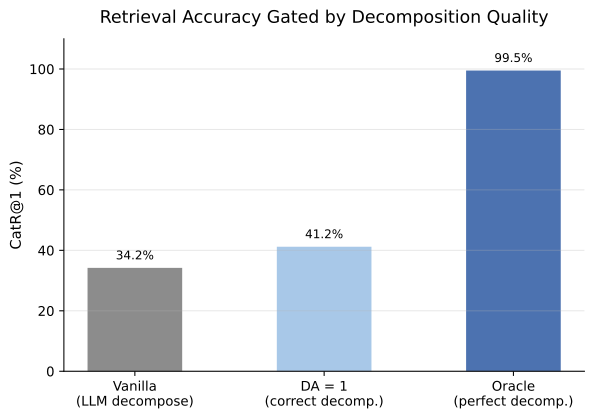
Here’s the surprise: if you give an LLM the perfect decomposition of that query into sub-tasks, retrieval accuracy hits 99.5%. But when the LLM decomposes the query itself, accuracy drops to 34.2%. A 65-percentage-point gap—and it’s entirely in the decomposition step, not the retrieval step.
This post walks through why decomposition fails, how to fix it with a method called Skill-Aware Decomposition (SAD), and why the fix works by correcting granularity rather than boosting model capacity.
Compositional Skill Routing
The Problem
LLM agents increasingly rely on external skills—reusable tool specifications that extend what the model can do. Early work like Toolformer taught models to call APIs autonomously; Gorilla scaled to massive API collections. With the Model Context Protocol (MCP) ecosystem now featuring thousands of skills across categories like file I/O, data processing, web search, and code execution, agents face a new challenge: real tasks require composing multiple skills, not just selecting one.
Prior work like SkillRouter has largely focused on single-skill selection: given a query, pick the best tool. But when a user says “download the dataset, transform it, and create visual reports,” no single skill suffices. The agent must:
- Decompose the query into atomic sub-tasks
- Retrieve the appropriate skill for each sub-task
- Compose the skills into an executable plan (DAG)
We call this Compositional Skill Routing. Each stage has its own challenges, but as we’ll see, one stage dominates.
SkillWeaver
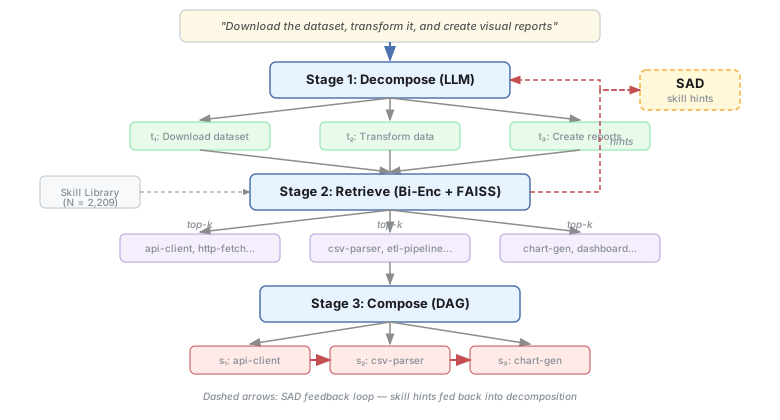
To study this problem, we built SkillWeaver, a three-stage framework:
- Stage 1 — Decompose: An LLM (Qwen2.5-7B-Instruct by default) breaks the query into sub-tasks. The input is the natural language query; the output is a list of atomic steps, each described in a sentence.
- Stage 2 — Retrieve: A bi-encoder (all-MiniLM-L6-v2, 384-dim) encodes each sub-task and searches a FAISS index of skill metadata. The top-k candidates per sub-task form the candidate set.
- Stage 3 — Compose: A compatibility-aware DAG planner arranges the selected skills into a dependency graph, ensuring execution order respects data flow constraints.
CompSkillBench
To evaluate, we built CompSkillBench: 300 compositional queries over 2,209 real MCP server skills spanning 24 functional categories, sourced from the public awesome-mcp-servers registry. Queries are stratified into three difficulty levels: Easy (2 skills), Medium (3 skills), and Hard (4+ skills).
Evaluation Metrics
Two metrics matter most:
- Decomposition Accuracy (DA): Does the number and identity of decomposed sub-tasks match the ground-truth skill set? DA=1 means exact match; DA±1 means off by at most one step.
- Category Recall at K (CatR@K): Of the top-k retrieved skills per sub-task, what fraction contain the correct category? This measures retrieval quality conditioned on the decomposition.
Decomposition as the Bottleneck
The Oracle Experiment
The first question: where does the pipeline fail? To isolate this, we ran an oracle experiment. We bypassed the LLM decomposer and fed the ground-truth decomposition directly into the retriever.
The result: CatR@1 = 99.5% with oracle decomposition. The retriever is essentially perfect when given the right sub-tasks.
Now the real number: with vanilla LLM decomposition (Qwen2.5-7B), CatR@1 drops to 34.2%. That’s a 65-percentage-point gap—entirely attributable to decomposition quality.
DA Gates Retrieval
We can see this gating effect more precisely. When we condition on DA=1 (correct decomposition), CatR@1 jumps from 34.2% to 41.2%—a 20% relative improvement. CatR@10 rises to 81.6%. The retriever isn’t broken; it’s being fed the wrong queries.
Why Decomposition Fails
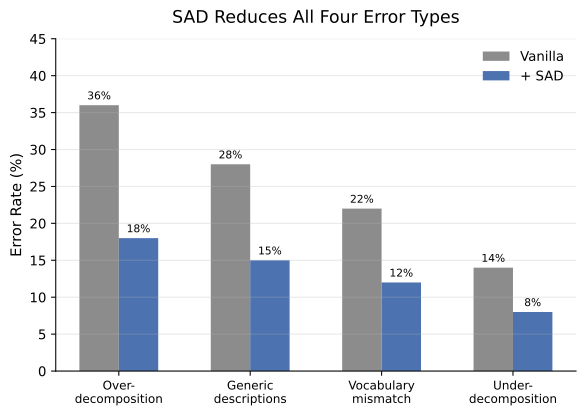
We analyzed 50 vanilla decomposition failures and found four recurring patterns:
- Over-decomposition (36%): The LLM breaks “download the dataset” into “check internet connection,” “find the URL,” “send HTTP request,” “save to disk”—four steps when one suffices. Each extra step introduces noise that degrades retrieval.
- Generic descriptions (28%): The LLM writes “process the data” instead of “parse CSV and compute statistics.” The description is too vague to match any specific skill.
- Vocabulary mismatch (22%): The LLM says “render visualization” but the skill library has “chart-gen.” Semantic gap between decomposition language and skill metadata.
- Under-decomposition (14%): The LLM merges “download” and “transform” into one step, losing the distinction needed to retrieve two different skills.
The common thread: the LLM decomposes without knowing what skills exist. It’s writing a recipe without seeing the ingredients.
This connects to a broader pattern in task decomposition research. Chain-of-Thought and Decomposed Prompting showed that breaking complex tasks into steps improves LLM performance. But these methods decompose in a vacuum—they don’t account for what tools are actually available. The result is sub-tasks that are technically correct but semantically misaligned with the skill library.
Skill-Aware Decomposition
The Idea
SAD (Skill-Aware Decomposition) addresses this with a simple feedback loop: retrieve skill hints first, then feed them back into the decomposition prompt.
Here’s the intuition: imagine ordering at a restaurant. If you’ve never seen the menu, you might ask for “something Italian”—vague, hard to match. But if you glance at the menu first, you can say “I’ll have the carbonara”—specific, exactly matchable. SAD gives the decomposer a glance at the skill library before it writes the sub-tasks.
How It Differs from Standard RAG
This is input-side feedback, not output-side. SAD retrieves skill hints to help the model decompose better—to ask better questions, not to give better answers.
- Output-side (standard RAG): Retrieve documents to help the model answer better. Examples: Self-RAG, ReAct, Reflexion.
- Input-side (SAD): Retrieve skill hints to help the model decompose better.
This distinction matters because it means SAD is complementary to any output-side RAG the agent might also use downstream.
Results
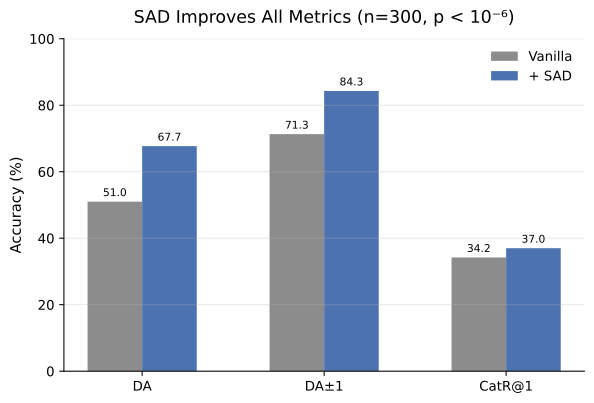
SAD improves decomposition accuracy from 51.0% to 67.7% (+32.7% relative, Wilcoxon p < 10⁻⁶, n=300) in a single iteration. DA±1 rises from 71.3% to 84.3%. Category recall improves from 34.2% to 37.0% at CatR@1 and 68.6% to 70.3% at CatR@10.
Convergence
One SAD iteration is enough for DA. CatR@1 continues to improve at round 2 (38.9%) before slightly declining at round 3, likely due to hint vocabulary fixation (Jaccard similarity rises 0.32 → 0.47 → 0.52, indicating progressive convergence to a stable skill vocabulary).
Granularity Correction, Not Capacity Boost
The Oracle-K Experiment
The key question: does SAD make the model smarter, or does it help it decompose at the right granularity?
To test this, we designed an oracle-step-count baseline. We give the LLM the correct number of sub-tasks (but not the content) and ask it to decompose. If SAD works by boosting capacity, this oracle should match SAD’s retrieval gains. If SAD works by correcting granularity, the oracle should close the DA gap but not necessarily the CatR@1 gap.
Results: oracle step count gives DA=99.3% but CatR@1=39.8%. Compare with SAD’s DA=1-conditioned CatR@1 of 41.2%. These are nearly identical.
SAD is a granularity corrector, not a capacity booster. It doesn’t make the model write better sub-task descriptions—it helps the model produce the right number of steps, which in turn enables the retriever to find the right skills.
Error Reduction
After SAD, the error distribution shifts:
- Over-decomposition drops from 36% to 18%
- Generic descriptions drop from 28% to 15%
- Vocabulary mismatch drops from 22% to 12%
- Under-decomposition drops from 14% to 8%
Generalization Across Models and Tasks
Cross-Model Validation
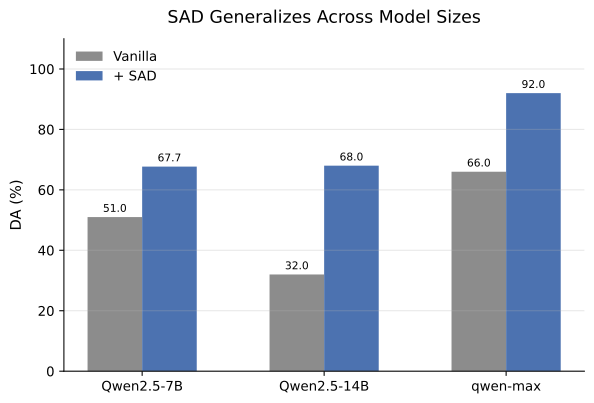
SAD generalizes across model sizes and families:
- Qwen2.5-7B: DA 51.0% → 67.7% (+32.7% relative)
- Qwen2.5-14B: DA 32.0% → 68.0% (+36pp absolute; the larger model over-decomposes more, but SAD corrects it)
- qwen-max (50 queries): DA 66.0% → 92.0% (+39.4% relative)
The 14B result is notable: vanilla decomposition is worse than 7B (32% vs 51% DA) because the larger model tends to over-decompose (avg 4.72 predicted steps vs ground-truth mean 2.94). SAD brings it down to 3.18—closer to the right granularity. Bigger isn’t always better; calibrated is better.
Human-Style Queries
We generated 200 human-style queries with zero overlap with the training set. These are messier, more natural-language versions of the benchmark queries. On these:
- Strict DA: 8.5% → 21.5%
- Relaxed DA±1: 30.5% → 50.5% (+66% relative)
SAD works on queries the model has never seen, written in natural human style.
Unseen Skills
We tested generalization to skills not in the retrieval pool:
- Category held-out (security + code-execution removed): +35.6% relative DA gain
- Random skill held-out (80/20 split): +23.2% relative DA gain
SAD generalizes because it teaches the decomposer the style of skills available, not specific skill names.
Paraphrase Robustness
On 200 paraphrased queries, DA drops by at most 6 percentage points; CatR@1 stays stable (33–38%). SAD is robust to surface-level wording variation.
Practical Implications
Context Window Reduction
The most immediate practical benefit: 99.9% context window reduction.
- Naïve approach: dump all 2,209 skill descriptions into the prompt → ~884K tokens
- SkillWeaver + SAD: retrieve only the needed skills → ~1,160 tokens (avg 2.9 skills per query)
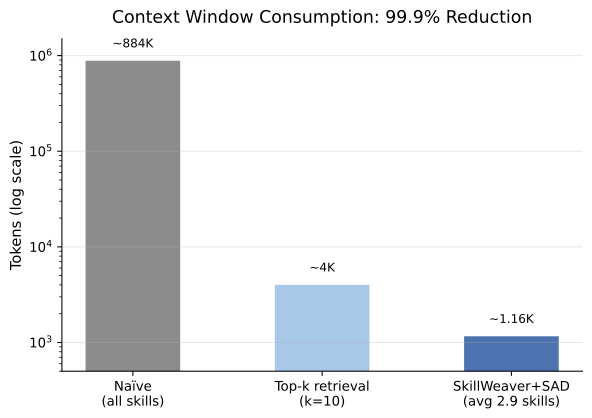
A 7B model with a 4K context window can route across 2,209 skills.
The Reranker Lever
SAD improves decomposition, but retrieval quality still has headroom. A pilot with an LLM-listwise reranker on top of SAD pushes CatR@1 from 37.1% to 40.9% (+10.3% relative, p < 0.01). The reranker and SAD are orthogonal—they fix different parts of the pipeline.
An encoder upgrade provides similar gains: swapping all-MiniLM-L6-v2 for BGE-base improves CatR@1 from 39.4% to 45.1% (+14.5% relative), also orthogonal to SAD.
End-to-End Pilot
The compose stage is still in pilot. On 30 queries with mock executors: DA = 86.7%, step execution success = 86.9%, chain completion rate = 76.7%. The compose stage introduces additional failure modes (dependency resolution, API compatibility) that warrant future work.
My Take
The “decomposition bottleneck” pattern likely generalizes beyond skill routing. Any system where a model must break down a task before retrieval—whether routing skills, selecting APIs, or planning multi-step queries—will hit this wall. The model doesn’t fail because it can’t find the answer; it fails because it asks the wrong question.
SAD’s input-side feedback is an underexplored direction. Most RAG research focuses on output-side: retrieve to answer better. SAD retrieves to ask better. This is a fundamentally different leverage point, and it’s cheap—one retrieval pass before decomposition, no fine-tuning, no model upgrade.
The MCP ecosystem makes this problem real. With 2,209 skills and growing, agents can’t brute-force by stuffing everything into the context window. Decomposition-aware routing isn’t a nice-to-have; it’s the only scalable path.
Citation
Please cite this work as:
Gao, Xueping. “Compositional Skill Routing: Decomposition Is the Bottleneck”. Xueping’s Blog (Jun 2026). https://hellogxp.github.io/posts/skill-routing/
Or use the BibTex citation:
@article{gao2026skillrouting,
  title   = {Compositional Skill Routing: Decomposition Is the Bottleneck},
  author  = {Gao, Xueping},
  journal = {hellogxp.github.io},
  year    = {2026},
  month   = {Jun},
  url     = "https://hellogxp.github.io/posts/skill-routing/"
}
References
[1] Gao, Xueping. “Compositional Skill Routing for LLM Agents: Decompose, Retrieve, and Compose”. arXiv:2606.18051 (2026). (This work — the source paper this post is based on.)
[2] Yao, S. et al. “ReAct: Synergizing Reasoning and Acting in Language Models”. ICLR 2023.
[3] Shinn, N. et al. “Reflexion: Language Agents with Verbal Reinforcement Learning”. NeurIPS 2023.
[4] Schick, T. et al. “Toolformer: Language Models Can Teach Themselves to Use Tools”. NeurIPS 2023.
[5] Asai, A. et al. “Self-RAG: Learning to Retrieve, Generate, and Critique through Self-Reflection”. ICLR 2024.
[6] Zheng, Y. et al. “SkillRouter: Retrieve-and-Rerank Skill Selection for LLM Agents at Scale”. arXiv:2603.22455 (2025).
[7] Patil, S. et al. “Gorilla: Large Language Model Connected with Massive APIs”. NeurIPS 2024.
[8] Wei, J. et al. “Chain-of-Thought Prompting Elicits Reasoning in Large Language Models”. NeurIPS 2022.
[9] Khot, T. et al. “Decomposed Prompting: A Modular Approach for Solving Complex Tasks”. ICLR 2023.
[10] Anthropic. “Model Context Protocol”. 2024.